Myanmar migrants struggle as second wave of Covid-19 hits Thailand

Discrimination has made the resurgence of the coronavirus in Thailand especially hard on Myanmar workers 

Published on Jan 10, 2021
Myanmar migrant workers are tested for Covid-19 in Mahachai, in Thailand’s Samut Sakhon province, in the first week of January 2021. (Photo: Supplied)

A second wave of Covid-19 infections in Thailand is taking a serious toll on migrant workers from Myanmar, as they face not only health risks and economic losses, but also discrimination from their hosts. 

An outbreak that began in Samut Sakhon province, west of the capital Bangkok, in mid-December has since spread to 54 of the country’s 76 provinces. Of these, 28 were declared pandemic “red zones” on January 5.

According to the government’s Centre for Covid-19 Situation Administration (CCSA), the country had 10,053 confirmed cases as of January 9. This compares with just over 6,000 cases reported during the first wave.

The CCSA figures don’t indicate how many Myanmar workers are among the infected, but Thai-based Myanmar civil society groups say the number is at least 1,700, most of them in Samut Sakhon.


Like many other Myanmar nationals living in Samut Sakhon, 41-year-old Aung Moe works in Mahachai, a district known for its seafood industry. He and his 30-year-old wife and nine-month-old daughter have all been diagnosed with Covid-19. 

On December 27, his wife became the first in the family to be admitted to Samut Sakhon Hospital with the disease. Their daughter, who became seriously ill on January 1, was tested for the virus and taken to the hospital five days later.


More than 4,000 Myanmar migrants work at the canning plant where Aung Moe is employed. He was the first there to contract Covid-19, although other cases had been reported in nearby factories.  

“Myanmar people have very low status here,” said Aung Moe, who comes from Dawei township. “We can’t count on support. We will be taken to the hospital only when our condition is really bad.” 

Aung Moe and his wife work legally in Samut Sakhon, which has about 500,000 workers from Myanmar employed in its port, seafood markets, and processing plants, many of them illegally.

“Thai people look at us with fear,” said Saw Lin Aung, the founder of Labour Hittai, a group that helps Myanmar workers in Thailand. “That is the most basic form of discrimination.”

A field hospital has been set up for infected migrants in Mahachai’s shrimp market in an effort to limit transmission of the disease, but local authorities say capacity needs to be greatly expanded.
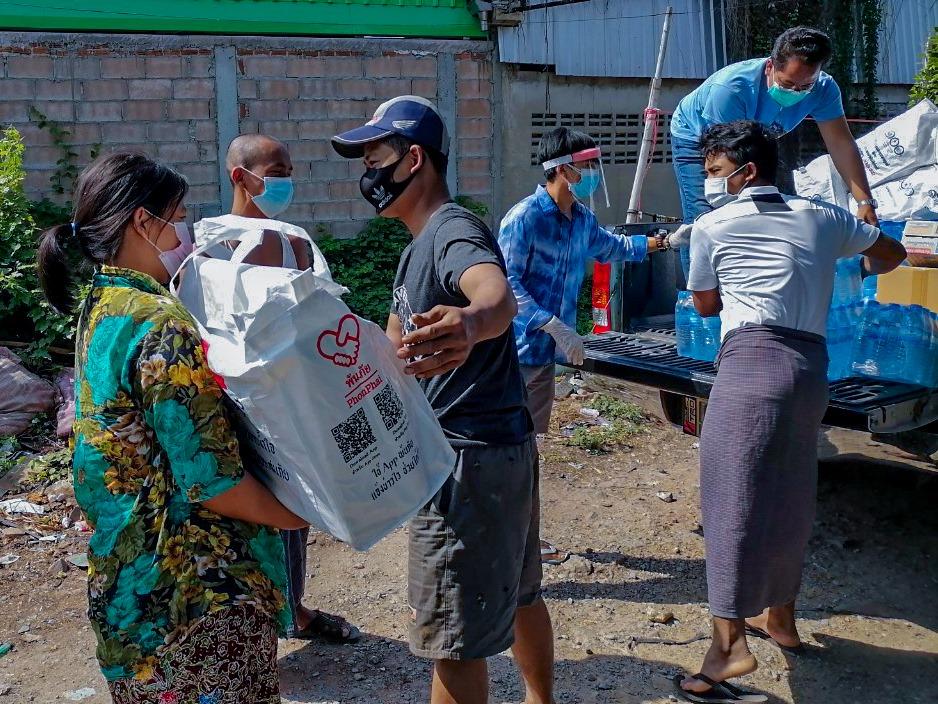
On January 4, tempers flared when around 30 Myanmar patients were discharged from the hospital and taken to a shopping mall that had been closed due to the pandemic.

The CCSA estimates that if efforts to contain the virus are not successful, infections could rise to 18,000 a day in January.

Meanwhile, Myanmar migrant workers are coming under increasing pressure due to the perception that they are responsible for the recent outbreak.

“Thai people look at us with fear,” said Saw Lin Aung, the founder of Labour Hittai, a group that helps Myanmar workers in Thailand. “That is the most basic form of discrimination.”

Speaking at a press conference on January 7, CCSA spokesperson Dr Taweesin Visanuyothin said that this attitude was impeding the response to the crisis.

“Local people do not accept the construction of a hospital in Samut Sakhon to accommodate Myanmar migrant workers. This is sad,” he said.

“When we try to build in a neighbouring district, people there also lodge protests,” he added.

However, cooperation between the governments of Thailand and Myanmar has helped to mitigate the severity of the situation facing migrant workers, said Aung Kyaw, the chairman of the Samut Sakhon-based Myanmar Migrant Workers' Rights Network.

He said he thanked the Thai government and the Myanmar embassy for following their pandemic code of conduct and protecting Myanmar nationals in Thailand.

“I have no income because I can’t work. But I can survive because there are many people who come to donate food,” said Ko Thet, a migrant worker in Mahachai.

The two sides should continue their cooperation in support of migrant workers after the Covid-19 outbreak, he added.

While the number of new cases continues to rise in central Thailand, including Samut Sakhon, the infection rate has not reached alarming levels in other parts of the country.

Kyaw Thu Moe, a Myanmar labour official based in Chiang Mai, said the northern Thai city remains relatively unaffected by the pandemic.

“Chiang Mai is calm and peaceful for the time being. The main infection areas are Mahachai and Bangkok and neighbouring areas. The coronavirus has not infected any Myanmar people in Chiang Mai,” he said.

So far, Myanmar citizens living in the southern Thai port city of Ranong, opposite Kawthaung in Tanintharyi region, also appear to be safe, according to Htet Wai Phyo, a labour official with the Myanmar embassy in Bangkok.

More than 300 Myanmar workers were tested for the virus in the Ranong area on January 6. 

Thai healthcare workers in personal protective equipment test Myanmar migrant workers for Covid-19 in the first week of January 2021. (Photo: Supplied)
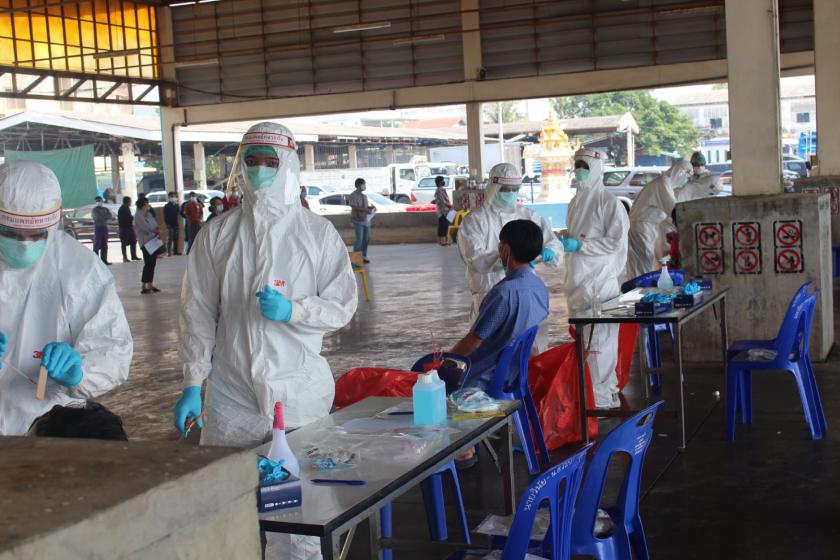
Htet Wai Phyo told Myanmar Now that the embassy’s focus was still on Mahachai, where Myanmar migrants forced out of work by the closure of markets and factories find themselves in a difficult situation. He said the embassy was meeting with employers to speak on behalf of workers.

Ko Thet, a migrant who lives near the shrimp market, said that he and five other members of his family, who all tested negative for the virus on December 30, have lost both their livelihoods and their freedom due to pandemic restrictions.

With both the market and the streets around it closed, he and his family are now completely dependent on others to provide for their basic needs.

“I have no income because I can’t work. But I can survive because there are many people who come to donate food,” he said.

To ease the pressure that many migrants are feeling, the Thai government announced on January 3 that it would issue special permits to allow workers from Myanmar, Cambodia and Laos to stay in the country until February 13, 2023.

To qualify, they must register online between January 15 and February 13 and find jobs before September 13.

But with most struggling just to meet their daily expenses, the only real hope for relief will come when the pandemic is finally brought under control, said Saw Lin Aung of Labour Hittai. 

If the crisis lasts too long, some may never recover from the lasting damage that Covid-19 has caused, he said.
Kyaw Lin Htoon is Senior Reporter with Myanmar Now

A resident said armed forces used drones to monitor the crowd before opening fire on them

Published on Mar 19, 2021
Men carry a wounded protester in Aungban, Shan State, on the morning of March 19 (Supplied)

At least eight anti-coup protesters were killed in Aungban, southern Shan State, during an attack by the military junta on demonstrations on Friday morning, according to the Aungban Free Funeral Service Society.

Sixteen military trucks carrying more than 100 policemen and soldiers arrived at the protest site at around 9:00 a.m. and began shooting at protesters. Seven died at the scene, and another protester who had been shot in the neck was taken to Kalaw Hospital and died by 11:00 a.m.

All eight victims were men. 

The body of the man who died at the hospital was sent to his family’s home, but those who were killed at the protest site were taken away by the junta’s armed forces, a representative of the Free Funeral Service Society told Myanmar Now. 

Aungban resident Nay Lynn Tun told Myanmar Now that police and soldiers had destroyed the doors of nearby homes in order to arrest people, and that at least 10 people had been detained. 

“Initially, police arrived at the site. When the crowd surrounded the police, armed soldiers arrived at the site and began firing,” he told Myanmar Now. “In the coming days, if we cannot gather to protest, we will do it in our own residential areas.”

Since March 13, around 300 volunteer night guards have watched over these residential areas to protect locals from the dangers posed by the junta’s nighttime raids. These forces use drone cameras to monitor the activities of the night guards from 3:00 a.m. until 5:00 a.m. every day, Nay Lynn Tun said. 

He added that hours before Friday’s crackdown, military and police had also used drone cameras to monitor the gathering of protesters in Aungban.

Over the last week, at least 11 protesters have been arrested in Aungban. Only three-- the protesters who were minors-- were released.

South of Shan State, in the Kayah State capital of Loikaw, two pro-democracy protesters were also shot with live ammunition by the regime’s armed forces on Friday. One, 46-year-old Kyan Aung, was shot in the lower abdomen and died from his injuries. The other wounded protester was a nurse, according to eyewitnesses. 

According to a March 18 tally by the advocacy group Assistance Association for Political Prisoners, at least 224 people have been killed across the country by junta’s armed forces since the February 1 coup. Thousands more have been arrested. 


Myanmar Now is an independent news service providing free, accurate and unbiased news to the people of Myanmar in Burmese and English.

Continue Reading

Those arrested include a BBC reporter and a former Mizzima correspondent. 

Published on Mar 19, 2021
Photojournalists take cover near the entrance of a monastery where military supporters gathered to attack protesters and media in Yangon on February 18 (EPA-EFE/LYNN BO BO)

A BBC journalist and a former Mizzima News reporter were arrested by men believed to be plainclothes officers in Naypyitaw on Friday afternoon, a family member confirmed.

BBC Burmese journalist Aung Thura was in front of the Dekkhina District court to report on a hearing for National League for Democracy patron Win Htein when he was arrested. Former Mizzima correspondent Than Htike Aung was with him at the time of the arrest.

No further details of the arrest or the reporters’ detention were known at the time of reporting, according to Aung Thura’s relative. 

“I saw some plainclothes officers dragging away a person in trousers into a car,” lawyer Min Min Soe, who was near the court at the time, told Myanmar Now. The man she saw is believed to be Than Htike Aung.  

“Two other officers in plainclothes were hassling another individual in a paso [traditional sarong for men] and glasses,” she said, referring to Aung Thura. “It was quite a scene so I don’t know what happened next.”

BBC News issued a statement on Friday afternoon saying that they are "doing everything [they] can" to find Aung Thura, who they described as being taken away by unidentified men.

“We call on the authorities to help locate him and confirm that he is safe,” the statement said.

As of March 16, a total of 38 journalists had been arrested or targeted for arrest since the February 1 coup. The latest arrests of the BBC and former Mizzima journalists push this number up to 40.  

Only 22 of these reporters have been released. Ten journalists have been charged with violating Section 505(a) of the penal code, which has been used against people who are seen as causing fear, spreading fake news, or agitating government employees. Under recent amendments to the law, the charges come with a three-year prison sentence if convicted.

Online news website The Irrawaddy has also been charged by the junta as violating the same statute for showing “disregard” for the armed forces in their reporting of the ongoing anti-regime protests.

Five publications, including Myanmar Now and Mizzima had their offices raided and their publishing licenses revoked earlier this month by the regime.

Editor's note: This story was updated to include the BBC's statement, which was not available at the original time of publishing.


Myanmar Now is an independent news service providing free, accurate and unbiased news to the people of Myanmar in Burmese and English.

Continue Reading

The offensives come in the wake of deadly crackdowns against anti-coup protesters in Myitkyina 

Published on Mar 18, 2021
A KIA soldier watches from an outpost in Kachin state in this undated file photo (Kachinwave) 

The Kachin Independence Army (KIA) launched attacks against police bases in the jade mining region of Hpakant on Thursday morning, a local resident told Myanmar Now. 

The attacks targeted police battalions where soldiers were stationed near Nam Maw village in the Seik Muu village tract.

“There are Myanmar police battalions around Nam Maw,” a resident said. At least three bases were attacked, he added. 

A 41-year-old civilian in Seik Muu village injured his left hand during the clash, the Kachin-based Myitkyina News Journal reported.

The KIA has launched several offensives against the coup regime’s forces recently. Fighting has also been reported in Mogaung and Injangyang this month. 

Some 200 people fled the Injangyang villages of Gway Htaung and Tan Baung Yan on Monday after the KIA launched an offensive against the military there. 

The offenses began in the wake of deadly crackdowns against anti-coup protesters in Myitkyina. The KIA has warned the junta not to harm anti-coup protesters. 


Myanmar Now is an independent news service providing free, accurate and unbiased news to the people of Myanmar in Burmese and English.

Continue Reading