Eight village tract administrators resign in Kawlin

In their resignation letters, the administrators claim they are stepping down for health reasons, but locals say they likely fear for their lives

Published on Jul 7, 2021
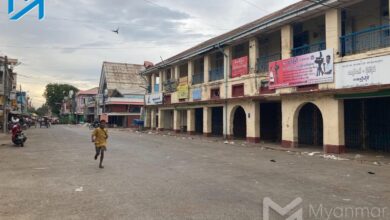
 Caption: Anti-coup protesters are pictured in Kawlin Township in early March (Photo: CJ)
Caption: Anti-coup protesters are pictured in Kawlin Township in early March (Photo: CJ)

As fighting between local resistance groups and the junta’s armed forces intensifies in Sagaing Region’s Kawlin Township, many local administrators have resigned.

On Sunday, eight village tract administrators submitted their resignations. They included Chit Naing of Oakkan, Aung Myint of Singaung, Min Shwe of Thayakchin, Win Zaw Tun of Gyopin, San Kae of Tagaung Eine, Myo Win Zaw of Taunggya, Htay Min of Moe Nan, and Thein Tun of Yintike. 

In their resignation letters, which have since gone viral online, the administrators said they were stepping down for health reasons. 

Kawlin residents told Myanmar Now that the village tract heads likely left out of concern for their safety; the killings of military-backed administrators across Myanmar has led others still holding the positions to fear for their lives. 

“The reason for their resignation is that the administrators do not consider themselves safe,” a local said. 

To date, no administrator has been killed in Kawlin Township. 

At the time of reporting, Myanmar Now was unable to make contact with the former administrators.

Fighting erupted in and around Kawlin after the killing of an alleged military informant on July 1. The following day, a military convoy was ambushed by the Kawlin People’s Defence Force (PDF) in Thitseinkone village, and fighting continued. 

The Kawlin PDF then attacked three military trucks in Kokkokone village that had been travelling from Shwebo. Two PDF members were reportedly killed in the July 4 clash. 

Outside of Kawlin, the Htigyaing and Katha township PDFs have also been fighting the junta’s army, and have been supported by troops from the Kachin Independence Army. 

Fighting broke out in Htigyaing and Katha on June 24 and 26. Representatives of the PDF reported that 44 of the coup regime’s soldiers were killed on those days and many more injured. 

On Tuesday, the military council’s forces conducted a massive search of houses in Kokkokone, a resident of Kawlin Township said.  

“I heard that around 13 military vehicles, including a tank, came from Shwebo. Yesterday, it was reported that they conducted searches of houses in villages in the area where fighting took place,” he told Myanmar Now on Tuesday, adding that Kokkokone was one of those villages.

Following the junta’s deadly crackdown on anti-dictatorship protesters, residents of Kani, Yinmabin, Depayin, Kalay, Tamu, Kawlin and Kantbalu townships in Sagaing Region have been fighting back against the military by using handmade rifles and other traditional weaponry. 

Clashes between the junta’s army and local PDFs have frequently broken out in neighbouring Chin State, as well as in Mandalay and Magwe regions, which also border Sagaing. 

As conflict escalates, a total of four people accused of acting as informants to the junta were killed in late June in Yinmabin Township’s Kapai and Theekone villages by unidentified perpetrators.

A member of Kawlin District’s military council was detained by locals in mid-March while he was reportedly informing the military about the activities and locations of anti-coup protesters. The army arrived at the scene and opened fire, killing one civilian. 

Myanmar Now is an independent news service providing free, accurate and unbiased news to the people of Myanmar in Burmese and English.

The oldest victim was an 80-year-old man who was shot in the head with his hands tied behind his back, sources said 

Published on Sep 13, 2021
A heavily-armed member of the junta’s armed forces stands guard in this file photo (EPA)

At least 18 people, including unarmed civilians, were killed by junta troops in Magway Region on Thursday, in the deadliest clash since the country’s opposition government declared a “resistance war” on the coup regime earlier this month.

Fighting between regime forces and a local resistance group broke out on Thursday in the village of Myin Thar in Magway’s Gangaw Township, according to locals.

Thirteen members of the group died in the clash, while five villagers—four people in their fifties and an 80-year-old man—were also killed, a local woman told Myanmar Now.

Tun Ngwe, the oldest victim, was shot in the back of the head with his hands tied behind his back, local sources said.

The bodies of those killed during the clash and the subsequent raid were cremated by surviving locals on Friday, the sources added. 

The local resistance fighters were defeated because they were young and inexperienced and had only antiquated handmade weapons to fight with, according to a relative of one person who was killed in the clash.

“Those from our defence group were kids who had just finished the 9th or 10th grade. They were all still too young. And they were killed in the clash,” the relative said.

A Myin Thar villager who was among those who retrieved the bodies of the local defence members said that eight of the 13 who were killed in the clash appeared to have been shot at close range. 

“Those who were not killed by artillery shells had mostly been shot in the temple by the soldiers. They were hiding when artillery shells hit, but the soldiers who later found them shot them dead for their defiance,” he said.

Clash by the river

Fighting started when junta troops arrived in Myin Thar from the nearby village of Thar Lin, where they had set fire to a house earlier that day. The two villages are on opposite sides of the more than 240-meter-wide Myittha River, with Thar Lin on the west side and Myin Thar on the east. 

After hearing about the raid on Thar Lin, Myin Thar residents moved to put up a barrier near a bridge between the two villages.

The resistance fighters positioned themselves on the eastern side of the river and fought against around 30 soldiers on the opposite side. The Myin Thar fighters initially had the upper hand in the clash, which lasted about an hour. 

We feel so bitter. We won’t forget it till the end of the world – a Myin Thar villager

Armed with primitive weapons, including hunting rifles and pipes filled with gunpowder, the resistance fighters fought against soldiers with AK-47s and other far more advanced guns, said a Myin Thar local who was involved in the clash.

“We managed to fire about 10 rounds that reached their side,” he said, describing how they used their makeshift pipe guns to fire across the river. He added that a number of soldiers were injured in this exchange. 

About 45 minutes into the clash, however, another 30 soldiers arrived as reinforcements and started using heavy artillery against them, he said. At this stage, the resistance forces started to sustain casualties and were forced to retreat. 

“They fired four, five rounds of heavy weapons and started advancing. They could see our situation from the other side of the river,” the man told Myanmar Now.

No longer facing any resistance, the soldiers stormed the village and occupied it until the following morning. By this time, however, many villagers had already fled to the forest or nearby farms, while some who were not able to hide took shelter at a Buddhist monastery outside the village. 

‘Terrorist’ resistance

In a statement released on Saturday, the National Unity Government (NUG) said that 11 of those killed on Thursday were under the age of 18. It also said that soldiers torched a total of 36 houses on Thursday and Friday. Locals said the damage was worth tens of millions of kyat. 

“Villagers, including women, children and elders hiding in a local monastery, were held on their knees under the sun. Their phones were [also] destroyed,” the NUG said in its statement. 

The reason for destroying the phones was to prevent people from documenting the aftermath of the raid and sending records to media outlets, according to the villagers.

“We feel so bitter. We won’t forget it till the end of the world,” said one woman. 

On Friday, the military said in a news report that about 50 “terrorists” had attacked soldiers near Myin Thar and its troops had to fire back. The report also said that there were numerous casualties among the attackers. 

The junta has declared the NUG, which was formed by elected members of the civilian government ousted on February 1, a terrorist organisation. It also refers to local armed resistance groups as “terrorists” in its announcements. 

After the raid on Myin Thar, about 60 soldiers marched to Hnan Khar, another village in Gangaw Township located on the western side of the Myittha River. Before arriving there at around 8am on Friday, they clashed with members of the Gangaw People’s Defence Force (PDF).

After planting landmines on the way to Hnan Khar, the Gangaw PDF ambushed the soldiers, fatally injuring around 15 of them, according to a statement released by the group.

The troops retreated but returned with reinforcements a few hours later, according to a source close to the Gangaw PDF. A combined force of around 100 soldiers used heavy artillery and machine guns to force the PDF fighters to retreat, the source added.

The soldiers who took control of Hnan Khar proceeded to set fire to houses in the village, destroying at least 36, according to residents. They later left at around 4pm.

No civilian casualties were reported, as the village’s residents had already fled. It was the third time that Hnan Khar had been raided by junta troops, following assaults in June and August

Key battleground

Residents of Hnan Khar were also among the roughly 10,000 people displaced when regime forces started violently cracking down on peaceful anti-coup protests in Gangaw in late March.

The military has been carrying out clearance operations in Gangaw and other Magway townships, including Yesagyo, Myaing, and Pauk, to quell armed resistance to its rule and crush PDF camps. 

Magway is bordered by Sagaing Region to the north and Rakhine and Chin states to the west. All are strongholds of anti-junta resistance and armed rebellion against military rule. 

Security and military experts say that due to its strategically important location, Magway Region will likely be a key battleground in the armed uprising against the coup regime. 

Myanmar Now is an independent news service providing free, accurate and unbiased news to the people of Myanmar in Burmese and English.

Continue Reading

Many of those imprisoned on the day of the military takeover had long been in the generals’ sights for questioning their right to rule

Published on Sep 12, 2021
Many of those imprisoned on the day of the military takeover had long been in the generals’ sights for questioning their right to rule

On February 1, the people of Myanmar woke up to their worst nightmare: the return of military rule after nearly a decade of relative freedom. The predawn arrest of State Counsellor Aung San Suu Kyi and President Win Myint signalled the end of a brief era of elected government and set the stage for the massive demonstrations and brutal crackdowns that were to follow.

But the country’s civilian leaders were not the only ones detained that day. Many others were also taken into custody, not because they presented any immediate threat to the coup makers, but because they had displeased them in the past.

Senior General Min Aung Hlaing, who orchestrated the military’s return to direct control over the state, moved swiftly to punish perceived enemies, locking them up even before they could utter a word of protest. Besides activists and politicians, his targets included celebrities, monks and other public figures who dared to question the army’s right to rule.

Some had already been marked for revenge before the coup. Charged with offenses related to their criticism of the military or its bigoted henchmen, they were among the first to be silenced when the time came to start settling scores.

Others, however, were arrested without even a pretence of legal justification. As with the allegations of voter fraud that served as the pretext for the military takeover, no serious evidence of wrongdoing was ever presented against them.

In every case, all that mattered was the alleged offenders’ attitude towards the class of men who consider themselves Myanmar’s natural rulers.

The profiles that follow provide a glimpse into the thinking of the generals and what they fear most—the prospect of losing power to those who refuse to fear them.

Mya Aye

Mya Aye, a veteran activist who played a leading role in the 1988 pro-democracy uprising, was taken away from his home on the morning of the coup and held incommunicado for the next two months. It was not until April 1 that his family learned that he was being held in Yangon’s notorious Insein Prison.

Their relief at finally finding out where he was soon turned to dismay, however, when they discovered that Mya Aye had been charged with hate speech under section 505c of the Penal Code, which deals with acts likely to incite a criminal offence against any group or individual based on their ethnic or religious background.

What made this so bewildering was the fact that, as a prominent Muslim political leader, Mya Aye had long been involved in interfaith efforts to end tensions between the country’s various religious communities.

The charges, which carry a possible sentence of two years in prison, stem from an email he sent from his mobile phone in November 2014. At the time, he was working with the ethnic affairs department of the 88 Generation Peace and Open Society, led by former student leader Min Ko Naing.

The email, which was related to Myanmar’s peace process, touched on the subjects of Burman ethno-nationalism and the need for cooperation among the country’s ethnic groups in order to achieve true federalism.

“The only reason he sent that email was for the country’s sake. No conflicts between ethnicities, races or countries resulted from that email sent in 2014,” said his lawyer, Thet Naung.

Mya Aye had been on the army’s radar since 1988, when he was a teacher who founded his own party to coordinate the efforts of younger leaders.

“We were student leaders and he was the party chair. We usually held our meetings at his party’s office, which was essentially a rebel’s hideout,” recalled former political prisoner Tun Kyi.

The only reason he sent that email was for the country’s sake. No conflicts between ethnicities, races or countries resulted from that email sent in 2014 – Mya Aye's lawyer

Mya Aye was imprisoned twice, in 1989 and 2007, and spent a total of 12 years behind bars. During his years of freedom, he remained politically active and often courted the military’s ire.

When the generals hinted before the coup that they might seize power again, Mya Aye described their words as an act of intimidation. He also rightly foretold the disastrous consequences of such a move.

“A coup would be really bad for the country. We’ll be looked down upon by the international community. It’s a losing battle for everyone, including the military itself, the people, the winning party of the election, everyone, really,” he said.

For those familiar with his career of speaking truth to power, Mya Aye’s arrest came as no surprise.

“They know exactly who their enemies are,” Tun Kyi said of the country’s dictators. “They regard every activist and politician who stands against them as their enemy. And they have a very strong grudge against them.”

Thura Aung Ko

Thura Aung Ko’s journey from high office to a prison cell was a long and unlikely one. But a full year before his arrest, it was clear that the former army general and government minister was a marked man.

In February 2020, after he suggested that the only reason the fugitive monk Wirathu remained at large was because the police answer to the military-controlled Ministry of Home Affairs, and not to the civilian government, army spokesperson Brig-Gen Zaw Min Tun called on the then-ruling NLD administration to “take action” against him for defamation.

But it was long before this episode that Aung Ko, a retired brigadier general who once served as deputy minister for religious affairs under the former junta, began his fall from favour with the military’s senior leaders.

When Myanmar made a transition to quasi-civilian rule under retired general Thein Sein in 2011, Aung Ko was one of the key holdovers from the military regime that held power until then.

As a prominent member of the military-backed USDP, he was elected to the Pyithu Hluttaw, or lower house of parliament, in 2010 and appointed chair of a judicial and legislative review committee. In this capacity, he advocated for the suspension of a clause in the constitution that barred then opposition leader Aung San Suu Kyi from becoming president, signalling a break with the military’s entrenched position on the matter.

In August 2015, when Thura Shwe Mann, the speaker of the Union parliament, was removed as chair of the USDP by a faction that felt he had grown too close to Suu Kyi, Aung Ko also found himself on chilly terms with the party. The two former generals, who share the “thura” title signifying courage in battle, were seen as allies who threatened to weaken the army’s hold over Myanmar politics.

When the NLD came to power after a landslide win in the 2015 election, Aung Ko was named minister of religion and culture despite losing his seat in parliament. As head of the ministry, he was instrumental in shutting down the ultranationalist group Ma Ba Tha, led by firebrand monk Wirathu, in July 2017.

Although Wirathu remained active after this, he was eventually prosecuted for sedition. After more than a year on the run, he turned himself in to the police just days before the 2020 election. (Imprisoned under the NLD government, he was pardoned and released by the junta earlier this month.)

On March 5, more than a month after his arrest on the day of the coup, Aung Ko was charged with corruption for allegedly awarding religious titles to individuals in exchange for bribes.

Currently being held in Insein Prison, the 74-year-old ex-general who made the mistake of displeasing higher-ranked hardliners now faces a sentence of 15 years behind bars.

Min Htin Ko Ko Gyi

Documentary filmmaker Min Htin Ko Ko Gyi is well-acquainted with the generals’ vindictiveness. Less than a year before his latest arrest, he was released from prison after serving a one-year sentence for writing Facebook posts critical of the military-drafted 2008 constitution and the army’s role in politics.

Accused of making derogatory remarks that harmed the dignity of the military, Min Htin Ko Ko Gyi was charged in April 2019 with incitement under section 505a of the Penal Code. He was freed in February 2020 after receiving routine sentence reductions, but was repeatedly denied bail during his incarceration, despite suffering from liver cancer.

A long-time critic of the military-backed Union Solidarity and Development Party (USDP) and Ma Ba Tha, the Buddhist nationalist organization that actively promoted anti-Muslim sentiment, Min Htin Ko Ko Gyi was “a thorn in the soles of the feet of the fascist generals,” as one colleague put it.

Part of the reason for this is that he had long been a supporter of the National League for Democracy (NLD) and its leader, Aung San Suu Kyi. One way he demonstrated this was by auctioning off a poem written by Suu Kyi for 240m kyat (nearly $145,000) and donating the proceeds to her party.

Despite being a well-respected filmmaker with an international reputation, Min Htin Ko Ko Gyi was unable to screen any of his early work in Myanmar because it was banned by the junta that ruled the country until 2011.

a thorn in the soles of the feet of the fascist generals

His 2010 documentary “The Floating Tomatoes”—about the environmental degradation of Inle Lake in Shan State—and his first film, “Human Zoo,” which examines the exploitation of the so-called “long-neck” Padaung people in Thailand, were well-received overseas, but couldn’t be seen at home due to the regime’s censorship.

When Myanmar began a partial opening a decade ago, Min Htin Ko Ko Gyi started organizing events to bring his own work and that of others to a Myanmar audience. For the first, the Art of Freedom Film Festival, he collaborated with Zarganar, a comedian and fellow director who was also known as a vocal opponent of military rule.

This was followed by the Human Rights Human Dignity International Film Festival and the founding of the Human Dignity Institute, which produces documentaries and short films on human rights.

his ideals as an artist and the passion and inspiration he has fostered in young filmmakers cannot be contained and will not be silenced – Min Htin Ko Ko Gyi's colleague

According to his colleague, who asked to remain anonymous, many young filmmakers owe their start to Min Htin Ko Ko Gyi. Through them and through his own films, he continues to influence public discourse in Myanmar, even as he remains a prisoner of the junta.

“The fascist regime may have succeeded [in detaining] Min Htin Ko Ko Gyi, but his ideals as an artist and the passion and inspiration he has fostered in young filmmakers cannot be contained and will not be silenced,” said the colleague.

Min Htin Ko Ko Gyi, 59, and his former collaborator Zarganar, 60, are both currently being held in Insein Prison, along with many others deemed a threat to the regime.

Htin Lin Oo

As he awaited his arrest on the morning of February 1, author and former NLD information officer Htin Lin Oo recorded a nine-minute live broadcast on social media to denounce the military’s actions. No matter what, he said, he would always oppose the dictatorship.

“I am not opposing the army. I am opposing the dictators who staged the coup. All of us civilians have to rise up and revolt against the dictatorship,” he said in his final public statement before being taken away.

Htin Lin Oo accused the generals of killing democracy in its infancy. Every time they staged a coup, he said, they threw the country decades behind the rest of the world, as they did when they seized power in 1962 and 1988.

Not surprisingly, these remarks did not sit well with Myanmar’s newly self-appointed leaders. After arresting him without charges, they hastened to use his online comments to charge him with incitement and spreading false news on social media.

As was the case with many others arrested that day, Htin Lin Oo had a history of displeasing the military. In a speech delivered in Magway Region’s Chaung Oo Township in October 2014, he accused the army of using religion to create conflict and maintain control.

A 10-minute excerpt from his two-hour speech was circulated widely online and portrayed as an attack on Buddhism, the religion of the majority in Myanmar. It proved so controversial that even his own party distanced itself from his remarks.

At the time, the military-backed USDP was in power and the Patriotic Association of Myanmar (the Buddhist nationalist group better known by its Burmese acronym Ma Ba Tha) was at the height of its influence. It came as no surprise, then, when Htin Lin Oo was sentenced to two years with hard labour for allegedly violating sections 295a and 298 of the Penal Code, which prohibit “deliberate and malicious acts intended to outrage religious feelings” and speaking “with deliberate intent to wound religious feelings”.

We’re not afraid of anything because we haven’t done anything wrong – Htin Lin Oo's wife

After his release, Htin Lin Oo resumed his efforts to push the military out of politics, organizing public discussions on amending the military-drafted constitution and founding a weekly journal, D Lann, that raised related issues.

His wife, Saw Sandar, said that the regime arrested Htin Lin Oo because it fears anyone who can lead the public.

“It’s not fair, but we have the courage to face this. We’re not afraid of anything because we haven’t done anything wrong,” she said, adding that her only real worry is that her husband will fall victim to Covid-19 while behind bars.

“What’s important is to stay healthy, especially when the pandemic is getting worse inside the prisons. That’s the only thing I’m worried about,” she told Myanmar Now.

Min Thway Thit

If he hadn’t been arrested on the day of the coup, Min Thway Thit would likely have been at the forefront of the anti-dictatorship movement. The 38-year-old activist and former political prisoner has long played a leading role in resisting military oppression.

He first came to prominence in 2014 during student protests against a new national education law introduced by the quasi-civilian administration of then President Thein Sein. During a violent crackdown on protests in Letpadan, Bago Region, in March 2015, he was one of more than 100 people arrested and imprisoned. The charges against him were eventually dropped, however, when the NLD assumed power a year later.

More recently, the former associate secretary of the All Burma Federation of Student Unions (ABFSU) and founder of the Oway Library and Education Charity (Thanlyin) led a volunteer group established in Yangon’s Thanlyin Township to respond to the Covid-19 pandemic.

Min Thway Thit was detained for a full month before the regime released any information about him to his family. His wife, Yadanar Su Po Khaing, told VOA’s Burmese-language service in an interview that she wasn’t able to send him any medicine or other necessities until early March, when she first learned that he was being held in Insein Prison.

He now faces charges of violating vehicle-licensing regulations under Section 95 of the Vehicle Safety and Vehicle Management Act, which carries a maximum sentence of three years in prison. However, according to his wife, he has refused to take part in the proceedings against him because he has no confidence in the impartiality of the junta’s judiciary.

Ministers, monks and satirists

The most common crime committed by those arrested on February 1 was supporting the NLD, the party that won two successive landslide victories against the military’s proxy party, the USDP. Anyone tied to the NLD, either as a leading member or as an outspoken supporter, was fair game for a regime determined to silence the military’s most potent rival for power.

Surprisingly, perhaps, only a handful of NLD-appointed ministers have come under sustained pressure. Apart from State Counsellor Aung San Suu Kyi and President Win Myint, the only senior figures from the Union government still in custody are Soe Win, the ousted minister of planning and finance, his vice minister Set Aung, and his predecessor Kyaw Win.

At the regional and municipal levels of government, however, a number of other senior officials have also been targeted by the junta. In early July, Mandalay’s chief minister, Dr. Zaw Myint Maung, and the region’s minister for electricity, energy and construction, Zarni Aung, were charged with corruption, more than five months after their arrest.

Similar charges, made in connection with alleged illegal deals involving Aung San Suu Kyi, have also been laid against Naypyitaw’s former mayor, Dr. Myo Aung, and deputy mayor, Ye Min Oo, as well as Min Thu, a member of the city’s development committee.

Of the monks who were arrested on February 1, Ven. Pyinya Thiha, better known as Shwe Nya Wah Sayadaw, was perhaps the most outspoken backer of the NLD. In 2011, long before the party came to power, he was banned from giving public sermons after he commemorated the 20th anniversary of Aung San Suu Kyi receiving the Nobel Peace Prize.

The abbot of Mandalay’s Myawaddy Mingyi monastery, Ven. Ariyawuntha Biwunsa (also known as Myawaddy Sayadaw), had also earned the military’s ire in the past. In late 2019, he was sued for defamation after he accused the armed forces of supporting ultranationalist monks. He was out on bail when he was arrested on the day of the coup.

In an interview with Myanmar Now following his release from Mandalay’s Obo Prison last month, he dismissed the junta’s claims that the NLD was bad for Myanmar’s Buddhist monks and repeated his charge that the military was trying to “exploit the people in the name of religion.”

Ven. Thawbita, one of the leaders of the 2007 Saffron Revolution, was taken away from his monastery in Patheingyi, east of Mandalay, in handcuffs on the morning of February 1. Two days later, he was sentenced to two years in prison after being found guilty under Section 66d of Myanmar’s draconian Telecommunications Law for an online comment he wrote more than two years earlier facetiously comparing Min Aung Hlaing to a cow.

As if to prove their utter humourlessness, the generals also went after a pair of prominent satirists on the day they seized power. One was Maung Thar Cho, who wrote satirical articles for the 7Day daily newspaper under the pseudonym of Jack (Kunchan Kone). These pieces proved immensely popular and earned him a following among NLD supporters, who invited him to literary talks around the country.

They were kidnapped and now they are political hostages. The junta chief will use them to ease international pressure

The other was Saw Phoe Khwar, an ethnic Kayin reggae musician who performed at NLD campaign events during last year’s election. Famous for his peace concerts, he is also well-known for his use of wit to skewer the military.

“The Son of Daw Sein Aye,” one of his most popular songs, plays on the name of the Defence Services Academy (DSA), the elite institution that produced most of Myanmar’s top military leaders. Ostensibly about an unruly man who makes trouble for his neighbours, it clearly refers to the DSA’s proudest alumni. Since the coup, it has become a popular protest song.

Whatever reasons were given for their arrest, most of those detained on February 1 are likely to remain in the junta’s custody until it becomes politically expedient to release them.

Locked up for offending the generals, they are now just pawns in their game, according to former political prisoner Tun Kyi.

“They were kidnapped and now they are political hostages. The junta chief will use them to ease international pressure. They may be released, but they won’t be free, because they could be arrested again at any time. That’s just how it was done under previous regimes, too,” he explained.

Myanmar Now is an independent news service providing free, accurate and unbiased news to the people of Myanmar in Burmese and English.

Continue Reading

After the Chinland Defence Force ambushed the troops in Thantlang, they say the military responded by firing heavy artillery into the town

Published on Sep 11, 2021
Shell casings left behind in Thantlang on September 9 (CJ)

Two Myanmar army soldiers were killed when the Chinland Defence Force (CDF) chapter in Thantlang, Chin State, ambushed the troops on Thursday, reportedly injuring four others.  

A spokesperson for the CDF-Thantlang said that the group launched a surprise attack while the junta soldiers were conducting inspections in the town at around 1pm.  

“They would come to every house and inspect people’s phones and their household registration. We attacked them because they have been harassing the people,” he said.

The CDF-Thantlang immediately withdrew from the area after the attack, to which the military responded by indiscriminately firing heavy artillery and guns into the town, according to the CDF spokesperson. 

Some of the shells hit houses in Thantlang, and at least one home was reportedly destroyed. 

After the fighting, junta’s soldiers cordoned off the town and launched thorough searches. On Friday morning, they continued the inspections of both houses and cars travelling through the area. 

The CDF-Thantlang has warned that if the junta continues their violence against residents of the township, they will attack them. 

Following the February 1 military coup and the junta’s subsequent brutal crackdown on anti-coup protesters, young people from across Chin State formed the Chinland Defence Force (CDF) and took up arms against the junta. 

On September 7, the shadow National Unity Government (NUG) announced the start of a “resistance war” against the junta. In Chin State, fighting has since broken out in both Hakha and Thantlang. 

Chin State’s guerrilla forces have been at the forefront of armed resistance against the coup regime. In recent months, fighting intensified in Hakha, Thantlang and Mindat in Chin State, killing hundreds of junta soldiers, according to local CDF groups.

Myanmar Now is an independent news service providing free, accurate and unbiased news to the people of Myanmar in Burmese and English.

Continue Reading