Activists urge NLD government to scrap repressive laws 

With dozens of political prisoners still behind bars, calls are growing for the ruling party to end the former junta’s legal legacy

Published on Nov 27, 2020
Student union members hold an anti-war protest in Yangon in July 2019. (Photo: Sai Zaw/Myanmar Now) 

Five years after coming to power, the ruling National League for Democracy (NLD) has done little to end some of the worst practices of the past, say activists who hope to see progress on this front in the party’s next term in office.

Pointing to the continued incarceration of dozens of political prisoners, these activists say that it is time for the ruling party—which emerged from the struggle against military rule—to remove repressive laws once and for all.

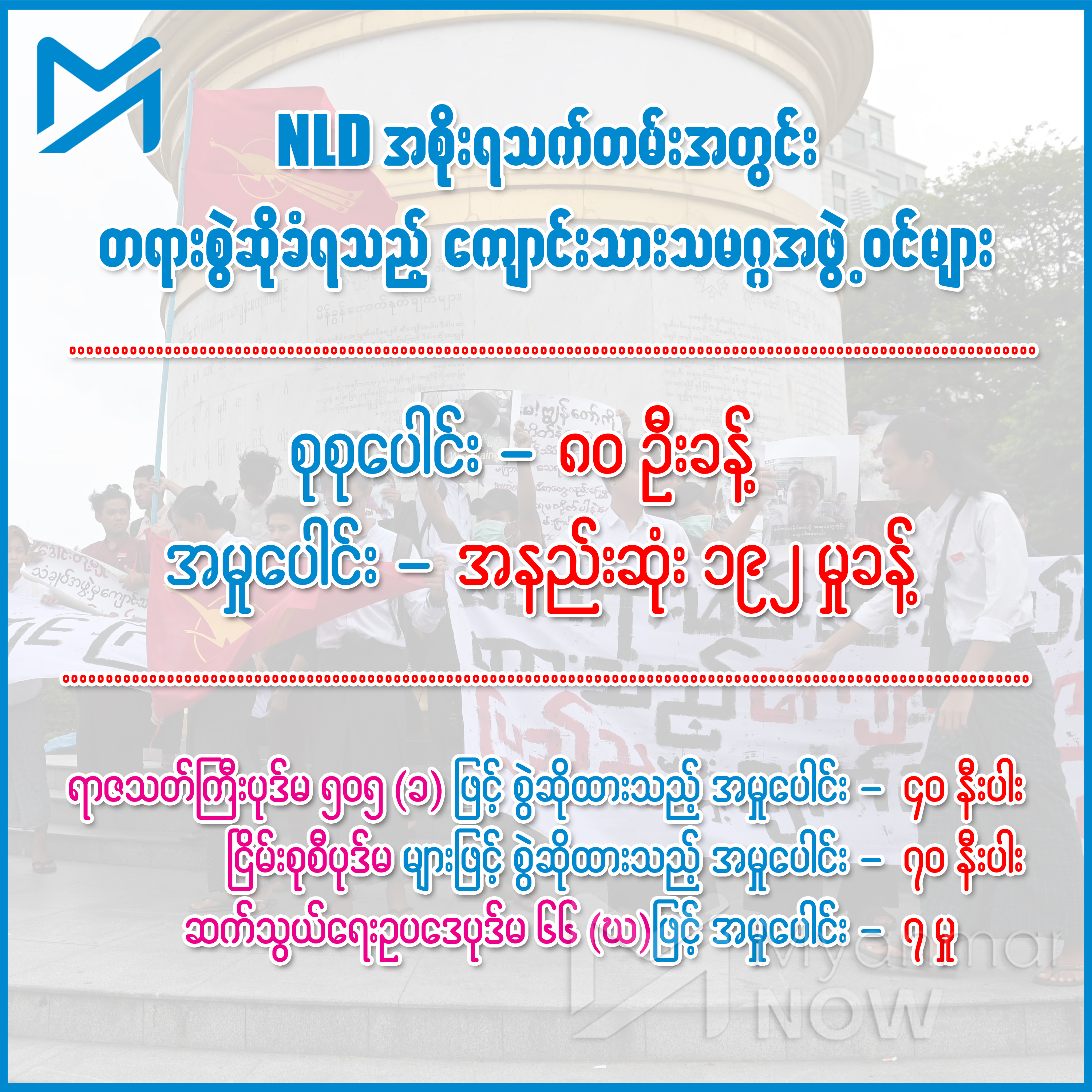
At present, there are at least 30 political prisoners still behind bars in Myanmar, and twice that many out on bail awaiting trial on charges under draconian laws drafted by the former colonial government or successive military dictatorships. 

Of these, around half are student union members serving or facing prison sentences for a host of offenses, from organizing anti-war protests and calling for an end the Internet blackout in Rakhine state to participating in labour strikes and criticizing university authorities.


Over the past five years, government or military authorities have filed more than 190 lawsuits against student activists for alleged violations of some of the country’s most outdated laws, including sections 505(a) and (b) of the colonial-era penal code, which makes it a crime to publish or circulate “any statement, rumour or report” that could incite members of the public to commit offences against the state or “public tranquillity”. 

More recent laws, such as the Telecommunications Law and the Peaceful Assembly and Peaceful Procession Law, both introduced under the quasi-civilian administration of former president Thein Sein, have also been invoked to silence critics of the government or military. In addition, some have been sued for contempt of court.


For some, the situation has barely improved at all after five years of NLD rule. “If students and the people are still being oppressed by those who would rather use these laws than repeal them, then it is no better than what we went through under the military regime,” said Kyaw Ko Ko, the former chair of the All Burma Federation of Student Unions (ABFSU).

The ABFSU has historically been at the forefront of the struggle for political freedom in Myanmar, ever since the country’s independence leaders first rose up against its British colonizers. Now, however, some say that it is inappropriate for it to continue these efforts under a government led by the NLD—as if the ABFSU were a greater impediment to progress than laws forged under repressive regimes of the past.
The government has, at times, suggested that it simply can’t change these laws for practical or political reasons. However, Aung Myo Kyaw, the head of the Yangon office of the Assistance Association for Political Prisoners, noted that the government has successfully amended a number of laws, including the Guest Registration Law, so it should be able to make some headway with laws that restrict people’s freedoms. 

The problem, he said, is that many in the government fail to see the need to make changes to laws that often prove useful in times of crisis. When they do decide to do something about them, they face resistance from the military and the Ministry of Home Affairs and quickly retreat. 

But NLD spokesperson Dr Myo Nyunt said that the party is open to amending laws that legal experts and the people deem to be outdated or inappropriate. “Under the current political circumstances, these laws are sometimes used,” he said, but added: “If the people say they should not be used, we have to think about that.”

Su Yadanar Myint, a member of the Peacock Generation Thangyat group who was released from prison in August after serving a two-year sentence under section 505(a) of the penal code and section 66(d) of the Telecommunications Law for criticizing the military, said it was “nonsense” for politicians to tell students that they shouldn’t continue their activism just because the NLD now holds power.

She noted that when the NLD was in opposition, it was on the right side of the same issues that student activists are still fighting for. When the Letpadan student protests broke out under the Thein Sein government over the National Education Law, for example, the NLD called it a “democracy issue”. Today, however, it is more likely to see it as a “law and order” issue.

This past year has been the worst in terms of prosecutions against student activists under the NLD government. Since the beginning of 2020, a total of 34 student union members have been taken to court to face charges stemming from their political activism. 

While most protests are directed at the military for its human rights abuses in Rakhine and Chin states, where it is fighting an ongoing civil war, many students are increasingly critical of the NLD for its silence on these abuses. 

“The NLD-appointed chief minister of Rakhine state has ignored the military’s crimes against humanity in Rakhine state and has not taken a firm stand for the people,” said Khaing Soe Lin, treasurer of the Rakhine State Students' Union.

Now that the NLD has won another resounding victory at the polls, expectations will be high that the party will finally deliver on its promises to prioritise the rights of the people over the might of the military. So far, however, it has fallen far short of the hopes of those with whom it once shared a common cause. 
Khin Moh Moh Lwin is Reporter with Myanmar Now.

Myo Set Pai is Fact-Checking Reporter with Myanmar Now

Those arrested include a BBC reporter and a former Mizzima correspondent. 

Published on Mar 19, 2021
Photojournalists take cover near the entrance of a monastery where military supporters gathered to attack protesters and media in Yangon on February 18 (EPA-EFE/LYNN BO BO)

A BBC journalist and a former Mizzima News reporter were arrested by the junta’s armed forces in Naypyitaw on Friday afternoon, a family member confirmed.

BBC Burmese journalist Aung Thura was in front of the Dekkhina District court to report on a hearing for National League for Democracy patron Win Htein when he was arrested. Former Mizzima correspondent Than Htike Aung was with him at the time of the arrest.

No further details of the arrest or the reporters’ detention were known at the time of reporting, according to Aung Thura’s relative. 

“I saw some plainclothes officers dragging away a person in trousers into a car,” lawyer Min Min Soe, who was near the court at the time, told Myanmar Now. The man she saw is believed to be Than Htike Aung.  

“Two other officers in plainclothes were hassling another individual in a paso [traditional sarong for men] and glasses,” she said, referring to Aung Thura. “It was quite a scene so I don’t know what happened next.”

As of March 16, a total of 38 journalists had been arrested or targeted for arrest since the February 1 coup. The latest arrests of the BBC and former Mizzima journalists push this number up to 40.  

Only 22 of these reporters have been released. Ten journalists have been charged with violating Section 505(a) of the penal code, which has been used against people who are seen as causing fear, spreading fake news, or agitating government employees. Under recent amendments to the law, the charges come with a three-year prison sentence if convicted.

Online news website The Irrawaddy has also been charged by the junta as violating the same statute for showing “disregard” for the armed forces in their reporting of the ongoing anti-regime protests.

Five publications, including Myanmar Now and Mizzima had their offices raided and their publishing licenses revoked earlier this month by the regime.


Myanmar Now is an independent news service providing free, accurate and unbiased news to the people of Myanmar in Burmese and English.

Continue Reading

The offensives come in the wake of deadly crackdowns against anti-coup protesters in Myitkyina 

Published on Mar 18, 2021
A KIA soldier watches from an outpost in Kachin state in this undated file photo (Kachinwave) 

The Kachin Independence Army (KIA) launched attacks against police bases in the jade mining region of Hpakant on Thursday morning, a local resident told Myanmar Now. 

The attacks targeted police battalions where soldiers were stationed near Nam Maw village in the Seik Muu village tract.

“There are Myanmar police battalions around Nam Maw,” a resident said. At least three bases were attacked, he added. 

A 41-year-old civilian in Seik Muu village injured his left hand during the clash, the Kachin-based Myitkyina News Journal reported.

The KIA has launched several offensives against the coup regime’s forces recently. Fighting has also been reported in Mogaung and Injangyang this month. 

Some 200 people fled the Injangyang villages of Gway Htaung and Tan Baung Yan on Monday after the KIA launched an offensive against the military there. 

The offenses began in the wake of deadly crackdowns against anti-coup protesters in Myitkyina. The KIA has warned the junta not to harm anti-coup protesters. 


Myanmar Now is an independent news service providing free, accurate and unbiased news to the people of Myanmar in Burmese and English.

Continue Reading

The coup regime’s forces took the injured people away and locals do not know their whereabouts 

Published on Mar 18, 2021
Kalay residents move the body of a man who was shot dead on Wednesday (Supplied) 

Four young men were killed and five people were injured in the town of Kalay in Sagaing region on Wednesday as protesters continued their fight to topple the regime despite daily massacres across the country aimed at terrorizing them into submission. 

The Tahan Protest Group gathered in the town at around 10am and police and soldiers began shooting. One young man was shot dead on the spot as he tried to help people who were trapped amid gunfire, residents told Myanmar Now.   

The regime’s forces also shot at and chased fleeing protesters along roads and through narrow alleys, a resident said.

“The crowd of protesters dispersed but one person was shot dead while trying to rescue those trapped in the protest site,” the resident added. 

As the crowd dispersed, a man riding a motorcycle was shot outside a branch of KBZ Bank. “He also died,” the resident said. 

Despite the murders, protesters gathered again in the afternoon around 4pm. Police and soldiers started shooting again and killed two people. 

“They were shot dead while trying to set up barricades at the protest site. They were shot while trying to obstruct the army’s way as the army troops chased and shot the trapped protestors,” the resident said. 

The two who were killed in the morning were identified as Salai Kyong Lian Kye O, who was 25, and Kyin Khant Man, who was 27 and had three children. The identities of the other two have not yet been confirmed.

Five people were also injured and then taken away. Locals said they did not know where they had been taken.   


Myanmar Now is an independent news service providing free, accurate and unbiased news to the people of Myanmar in Burmese and English.

Continue Reading