A Yangon township reels from an assault on young lives and human decency

Eight protesters were confirmed dead after Wednesday’s crackdowns in North Okkalapa, with dozens more injured and many others still unaccounted for

Published on Mar 6, 2021
 Relatives mourn at a memorial to honour a protester who has fallen in North Okkalapa. (Myanmar Now)
Relatives mourn at a memorial to honour a protester who has fallen in North Okkalapa. (Myanmar Now)

Win Khant Maung did not move. He had bruises all over his body. You only knew he was alive from the low moans he made as he lay there in agony.

The 18-year-old was arrested at around 10am on Wednesday for taking part in an anti-junta protest near Kantharyar park in Yangon’s North Okkalapa township.

After he was apprehended, Win Khant Maung was forced to spend the entire day in the back of a prison truck. At around 5pm, he was finally transferred to Insein prison, where police and military personnel brutally assaulted him, inflicting his near-fatal injuries.

Later that night, he and a number of others ended up at the Shwe Pauk Kan police station. The police informed a volunteer group, who then contacted ward officials. This is how the families of the detainees learned what had happened to them.


signal-2021-03-04-201552_003.png

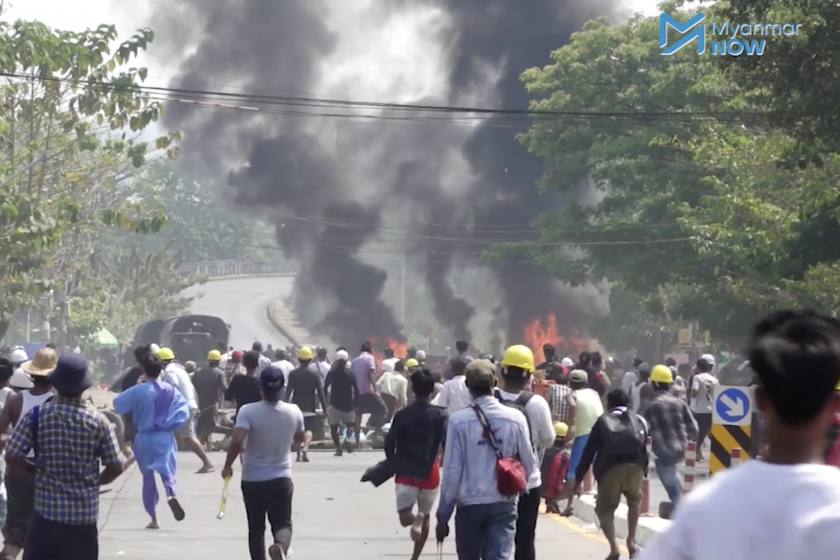
Soldiers and police start burning tires used by protesters to form a barricade. (Myanmar Now)


Many were distraught when they saw how their loved ones had been treated.

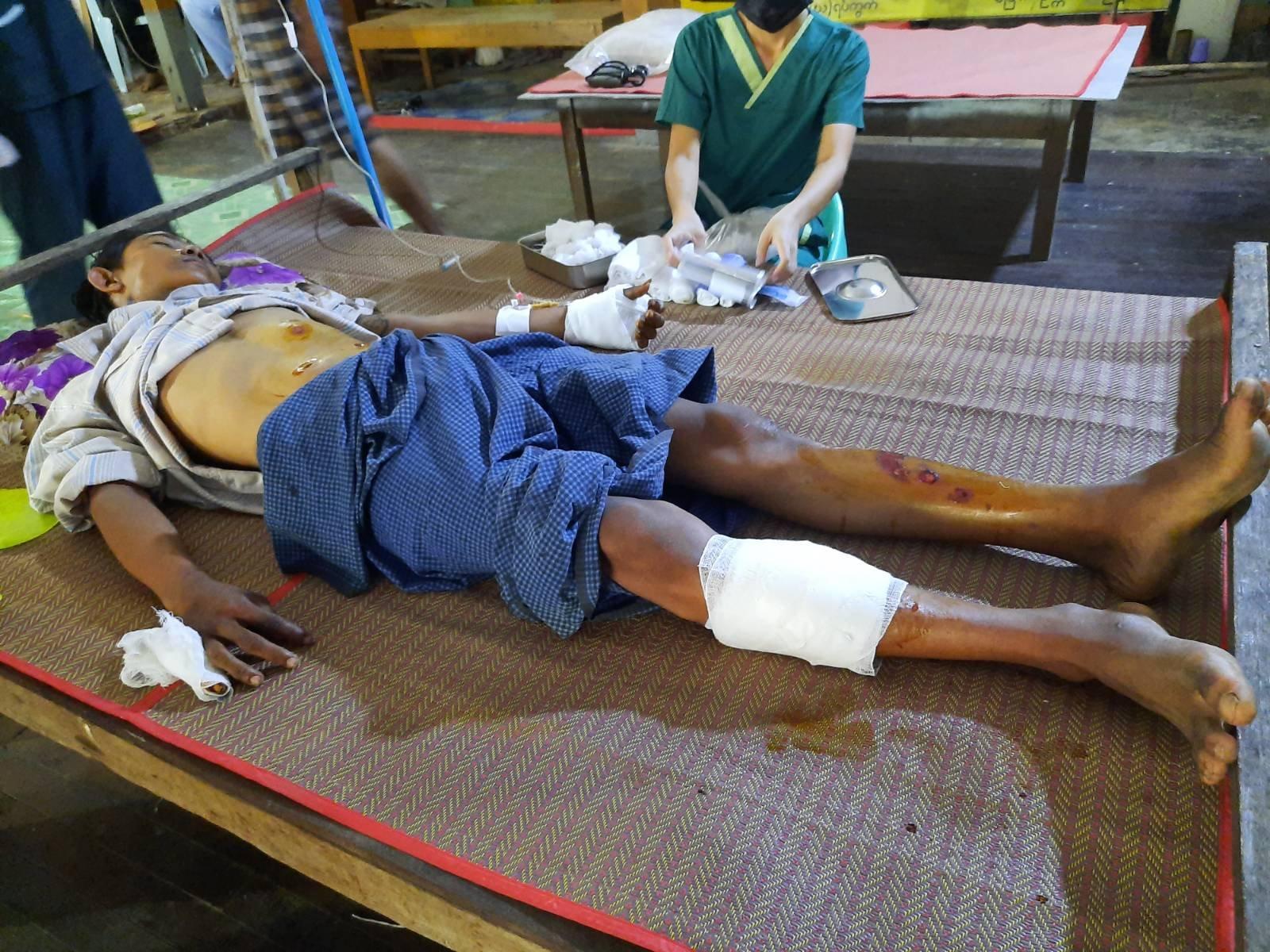
“He was covered in bruises—at least 30 of them. You can’t even touch his head. They hit him in the groin as well, and his legs, his arms, his knees. Everywhere!” Win Khant Maung’s mother said, sobbing.

“He didn’t have a weapon. There was no need for this level of abuse,” she added with anguish in her voice.

Currently, doctors involved in the Civil Disobedience Movement are tending to his injuries. Because he can’t be sent to a hospital, he is being cared for in a religious hall in his ward.
signal-2021-03-04-130435_007.jpeg

Anti-coup protester Win Khant Maung receives medical treatment after being tortured in custody. (Myanmar Now)

‘Kill them all!’

March 3 was a day of escalation in the ruling junta’s war on unarmed protesters opposed to its February 1 takeover. Using live ammunition, it killed dozens of people around the country and wounded many more. There were casualties reported in Mandalay, Monywa, Myingyan, Salay and Mawlamyine.

But North Okkalapa, in the northern outskirts of Yangon, is where security forces unleashed the worst violence that day.

It started early, as thousands of people approached the North Okkalapa roundabout to begin another day of protests first thing in the morning. A combined force of soldiers and police blocked their way at the roundabout and the bridge leading into the township.

The protesters slowly backed away rather than face a direct confrontation, but then the crackdown began without warning.

“We were stepping back slowly because we thought we could reason with them. Then, all of a sudden, the soldiers and police got off their trucks. Five minutes later, they started firing rubber bullets and throwing smoke bombs,” a protest leader told Myanmar Now.

Even after five smoke bombs were used against them, the protesters held their ground. That’s when the soldiers started lobbing tear gas canisters. Soon, they moved on to live ammunition.

At this point, the protesters were forced to flee into side streets to escape, their pursuers close behind them.

“They even hit people who let us into their homes. When some of us ran into houses on Nweni 6 lane, they came right inside the houses, swearing and hitting. Hitting people with guns! And kicking them with their military boots,” the protest leader recounted.

Hiding inside, the protesters could clearly hear conversations between the soldiers and police.

“We heard them saying, ‘Can’t you shoot? What are you afraid of? Shoot them all! Kill them all!’” the protest leader said.
nokl_0.jpg

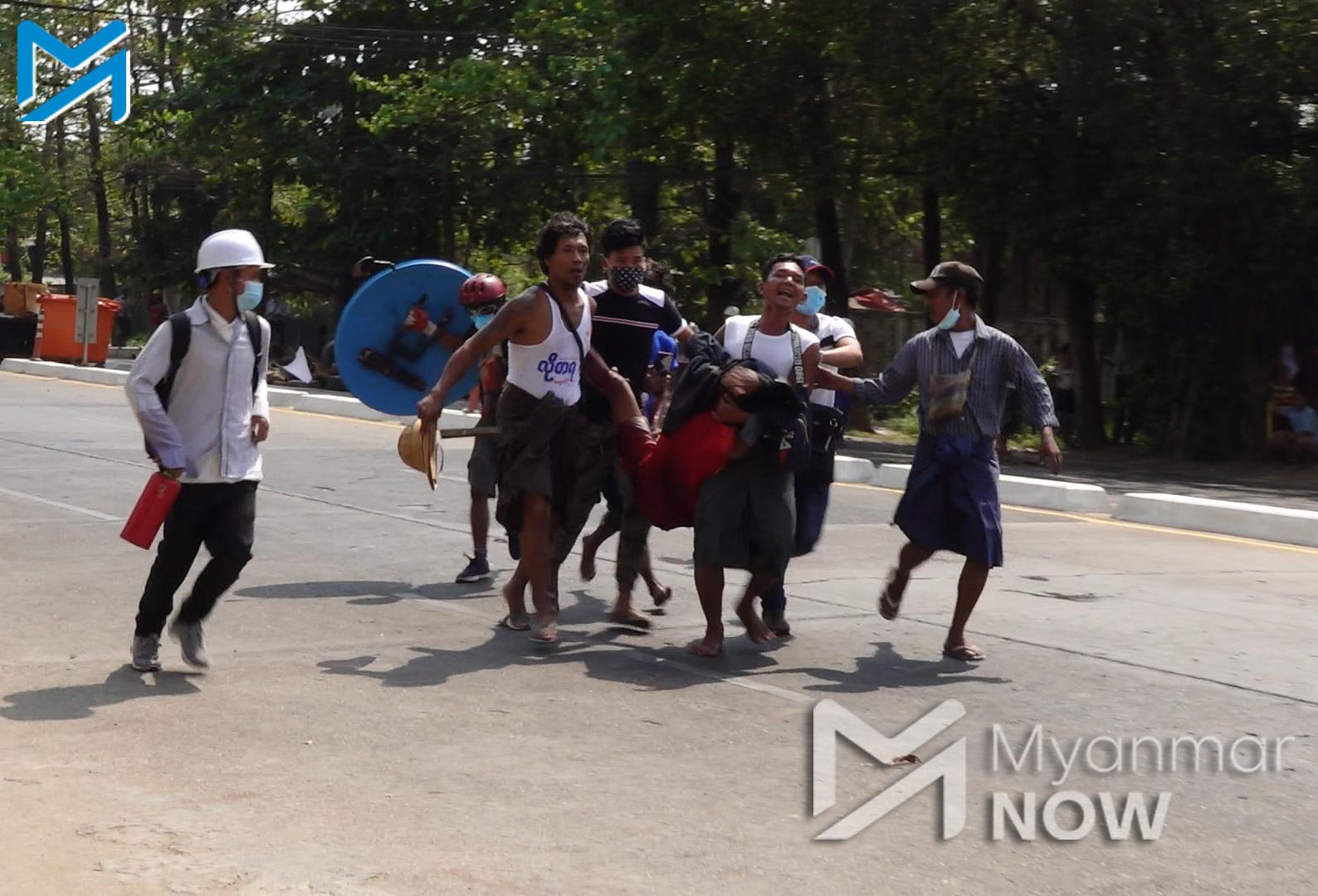
Protesters carry an injured protester. (Myanmar Now)

Mid-day massacre

Three of the protesters were captured sometime before noon, but this didn’t stop the others from regrouping. Using car tires, they set up a barricade near the bridge.

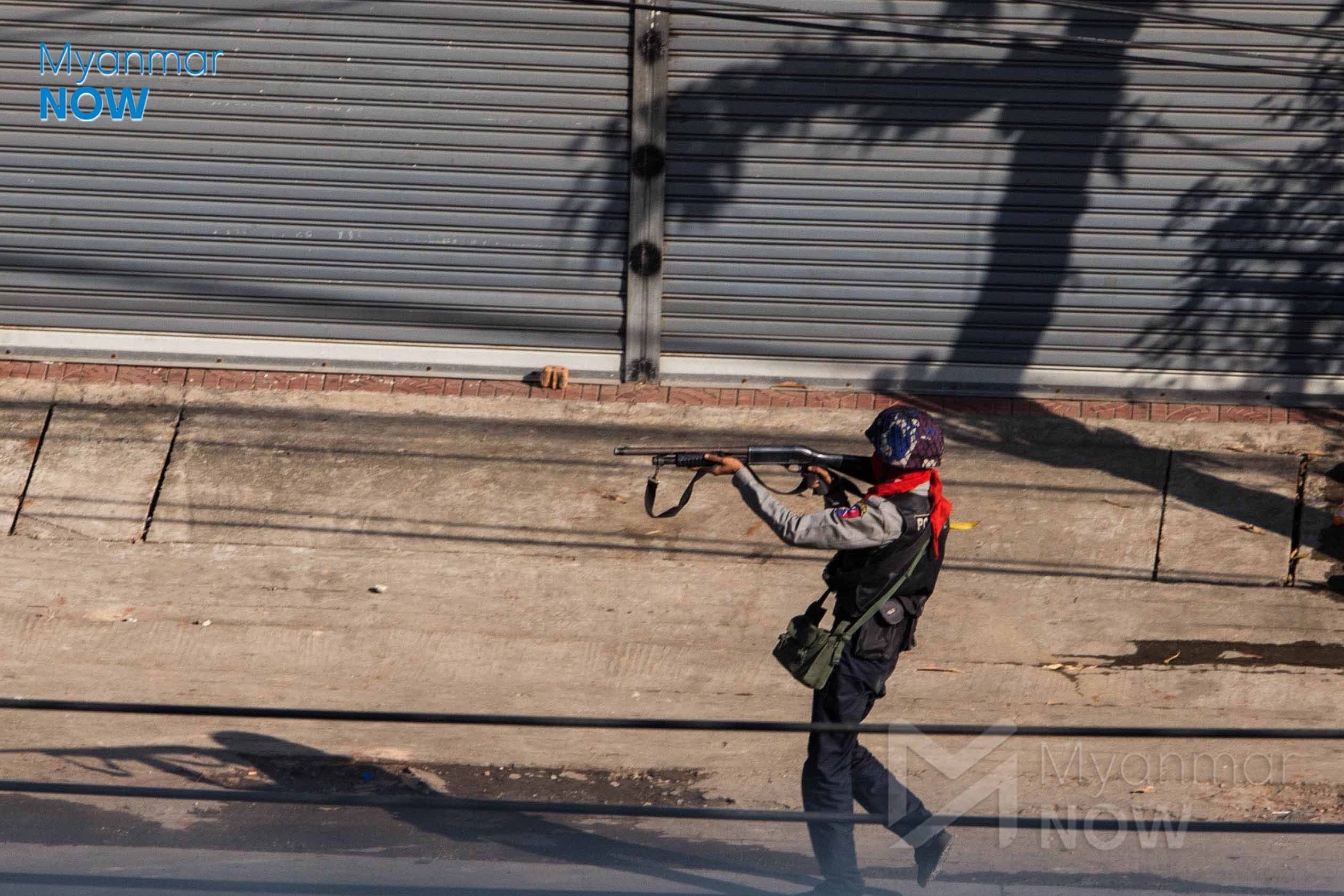
Then, at around 1pm, the soldiers and police started cracking down again, setting the tires on fire and shooting at the protesters, this time to kill.

Htet Aung, a 19-year-old protester, was one of the first casualties. He died of a gunshot wound to the chest, according to a doctor who attempted to save his life.

Min Oo, 20, who was also among the first to fall, was shot in the pelvic region and died at the hospital that evening.

Another unidentified protester was shot in the back after he was caught trying to flee. A video of the incident shows him being kicked after he falls to the ground and later dragged away, possibly dead.

Many near the bridge attempted to escape this killing spree, but were soon captured. More than 100 young protesters were rounded up, and as they were being herded into three military trucks, local residents started shouting, demanding their release.

This was met with another violent—and this time even more deadly—outburst from the security forces.

“When we yelled, ‘Give us the students back,’ they started firing. First they used rubber bullets, then stun grenades. When the crowd dispersed, they started firing with machine guns. We saw these kids in the front drop one by one,” said Ye Kyaw Thu, an emergency volunteer who witnessed the scene.

The soldiers took their positions after getting off the trucks and fired non-stop with semi-automatic weapons, he recalled.

Although they were facing unarmed civilians, the soldiers kept shooting at them like they were enemies on the battlefield, he added.

“Before we could tell everyone to get down, those at the front started to drop. The soldiers used tear gas and machine guns against the crowd for like five minutes. After they threw a few more stun grenades and tear gas canisters, the trucks left,” said Ye Kyaw Thu, who helped get eight victims of this brutal attack to the nearest emergency clinic.
img_5998.jpg

A policeman shooting at the protesters in Yangon on March 4. (Myanmar Now) 


A night of terror and torture

The brutality did not end there. Emergency rescue workers were also targeted, including three who were seen being viciously beaten in CCTV footage that later went viral.

As the three kneeled on the ground near their ambulance, police took turns kicking them and landing heavy blows to their heads and bodies with batons and rifle butts.

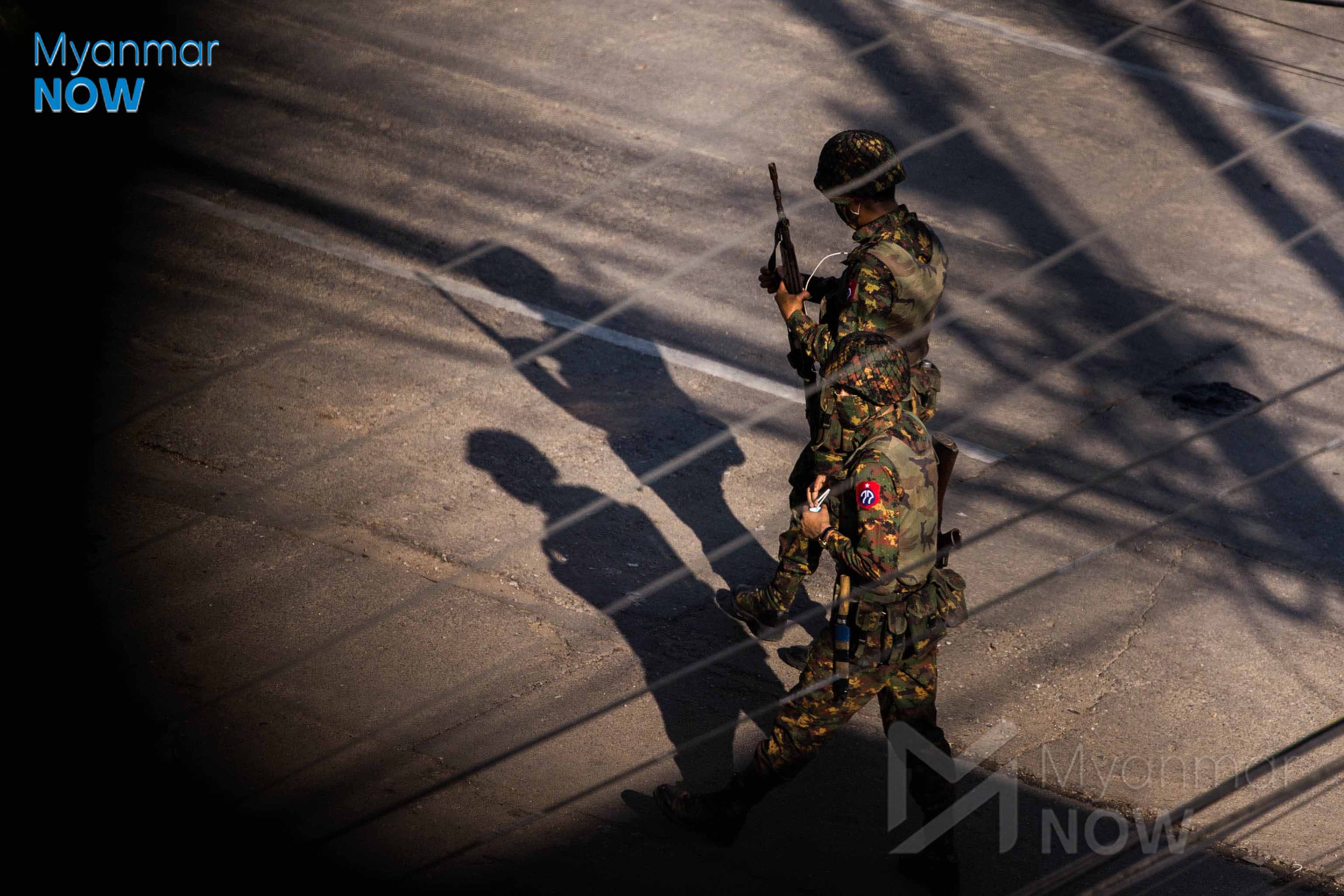
Later that night, security forces continued to terrorize the residents of North Okkalapa. At about 11pm, around 20 military trucks entered the township and started firing indiscriminately, according to witnesses.

Most of these vehicles then proceeded to North Dagon township for a raid on the office of the Free Funeral Service Society (FFSS), one of Myanmar’s most respected charities.

In addition to damaging office equipment, soldiers and police also physically assaulted 10 members of the FFSS staff.

A few of the trucks, however, took a detour to the Shwe Pauk Kan police station, where they dropped off eight seriously injured protesters, including Win Khant Maung.

“The military trucks were shooting to clear a path, warning people to stay off the street. Then they dumped the eight injured people in front of the police station,” said a social worker who helped the injured protesters get medical attention.
img_6105.jpg

Soliders approaching a protest site in North Okkapla township in Yangon on March 4. (Myanmar Now) 

A doctor who attended to Win Khant Maung said his injuries were likely caused by rubber bullets shot at close range.

“These aren’t injuries he received during the crackdown. This was deliberate torture after his arrest. They shot him with rubber bullets. That’s why he has this many injuries,” the doctor told Myanmar Now.

Eight people were confirmed dead from the various crackdowns in North Okkalapa on Wednesday, while another 73 sustained serious injuries, some of them life-threatening.

More worrying, said doctors, is that there have been multiple reports of people unaccounted for. At least some of the missing persons are presumed dead.

According to a UN official, there were at least 38 deaths nationwide on March 3, making it the deadliest day so far in the now month-long struggle to force Myanmar’s junta to restore civilian rule.



Myanmar Now is an independent news service providing free, accurate and unbiased news to the people of Myanmar in Burmese and English.

The offensives come in the wake of deadly crackdowns against anti-coup protesters in Myitkyina 

Published on Mar 18, 2021
A KIA soldier watches from an outpost in Kachin state in this undated file photo (Kachinwave) 

The Kachin Independence Army (KIA) launched attacks against police bases in the jade mining region of Hpakant on Thursday morning, a local resident told Myanmar Now. 

The attacks targeted police battalions where soldiers were stationed near Nam Maw village in the Seik Muu village tract.

“There are Myanmar police battalions around Nam Maw,” a resident said. At least three bases were attacked, he added. 

A 41-year-old civilian in Seik Muu village injured his left hand during the clash, the Kachin-based Myitkyina News Journal reported.

The KIA has launched several offensives against the coup regime’s forces recently. Fighting has also been reported in Mogaung and Injangyang this month. 

Some 200 people fled the Injangyang villages of Gway Htaung and Tan Baung Yan on Monday after the KIA launched an offensive against the military there. 

The offenses began in the wake of deadly crackdowns against anti-coup protesters in Myitkyina. The KIA has warned the junta not to harm anti-coup protesters. 


Myanmar Now is an independent news service providing free, accurate and unbiased news to the people of Myanmar in Burmese and English.

Continue Reading

The coup regime’s forces took the injured people away and locals do not know their whereabouts 

Published on Mar 18, 2021
Kalay residents move the body of a man who was shot dead on Wednesday (Supplied) 

Four young men were killed and five people were injured in the town of Kalay in Sagaing region on Wednesday as protesters continued their fight to topple the regime despite daily massacres across the country aimed at terrorizing them into submission. 

The Tahan Protest Group gathered in the town at around 10am and police and soldiers began shooting. One young man was shot dead on the spot as he tried to help people who were trapped amid gunfire, residents told Myanmar Now.   

The regime’s forces also shot at and chased fleeing protesters along roads and through narrow alleys, a resident said.

“The crowd of protesters dispersed but one person was shot dead while trying to rescue those trapped in the protest site,” the resident added. 

As the crowd dispersed, a man riding a motorcycle was shot outside a branch of KBZ Bank. “He also died,” the resident said. 

Despite the murders, protesters gathered again in the afternoon around 4pm. Police and soldiers started shooting again and killed two people. 

“They were shot dead while trying to set up barricades at the protest site. They were shot while trying to obstruct the army’s way as the army troops chased and shot the trapped protestors,” the resident said. 

The two who were killed in the morning were identified as Salai Kyong Lian Kye O, who was 25, and Kyin Khant Man, who was 27 and had three children. The identities of the other two have not yet been confirmed.

Five people were also injured and then taken away. Locals said they did not know where they had been taken.   


Myanmar Now is an independent news service providing free, accurate and unbiased news to the people of Myanmar in Burmese and English.

Continue Reading

An ex-convict businessman says that he gave the State Counsellor more than $550,000 in cash when ‘there was no one around.’ 

Published on Mar 18, 2021
Maung Weik (first from left) is pictured near State Counsellor Aung San Suu Kyi at the opening ceremony of a government housing built by his Say Paing Company. (Maung Weik/ Facebook)

The military council announced on March 17 that it would attempt to charge State Counsellor Daw Aung San Suu Kyi, who has been detained since Myanmar’s February 1 coup, with corruption.

The junta’s move is linked to new allegations against Aung San Suu Kyi by businessman Maung Weik. The owner of the Say Paing construction and development company, Maung Weik was formerly imprisoned on drug charges and is known to have close relationships with members of the military’s inner circle.  

Military-run media aired a recorded statement made by Maung Weik alleging that he had given Aung San Suu Kyi more than US$550,000 in cash-filled envelopes on the four occasions he met her between 2018 and 2020. 

“There was no one around when I gave her the money,” he said in the video statement. 

Under Myanmar’s earlier military regime, Maung Weik maintained ties to several generals, including former intelligence chief Khin Nyunt.

He was sentenced to 15 years in prison on drug charges in 2008, but was released in 2014 while the country was led by the military-backed Union Solidarity and Development Party.  

Upon his release, Maung Weik founded Say Paing–a construction company–and ran various business ventures through his connections to military officials.  

Maung Weik’s wife is also the niece of military-appointed Vice President Myint Swe, who was also the former chief minister of Yangon under the former military administration. 

The coup council announced on March 11 that the now-ousted National League for Democracy’s (NLD) Yangon Region chief minister Phyo Min Thein had given Aung San Suu Kyi $600,000 and more than 11 kilograms of gold. The announcement provided no reason as to why the money and gold were allegedly given to the State Counsellor by the chief minister. 

A top NLD figure told Myanmar Now that the funds in question were donations to build a pagoda. 

“They’re trying to fabricate this and ruin [Aung San Suu Kyi’s] reputation, but the public already clearly knows it’s not true. There’s no need to say anything else,” the official said. 

The junta has also accused the Daw Khin Kyi Foundation and an affiliated project, the La Yaung Taw Academy, of losing public funds. The foundation was founded by Aung San Suu Kyi and named after her late mother. 

According to the military council, the land lease for the Daw Khin Kyi Foundation’s headquarters, located on Yangon’s University Avenue, is not commensurate with the market price for land in the area. It argues that the country had lost more than 1 billion kyat (more than $700,000) in public funds as a result.

The junta declared that from 2013 to 2021, more than $7.9 million in donations from foreign NGOs, INGOs, companies and individual international donors flowed into the foundation’s three foreign currency accounts.

Also under investigation by the junta is the La Yaung Taw Academy in Naypyitaw, which trains young people in environmental conservation and horticulture in association with the Daw Khin Kyi Foundation. The military said the rate at which the land for the project was purchased came at a discount of at least 18 billion kyat (more than $12.7 million), which was subsequently a loss to the state. 

It also reportedly included some plans—such as the construction of a museum—that used funds in a way that strayed from the project’s, and the Daw Khin Kyi Foundation’s, original aims.

“The construction of a building with finance from the foundation for the chair of the foundation has deviated from the foundation’s objective,” the March 17 announcement in the military-run newspaper said. 

Prior to the corruption allegations, the military council had hit Aung San Suu Kyi with four charges at the Zabuthiri Township court in Naypyitaw.

She has been accused of violating Section 505(b) of the Penal Code for incitement, which carries a sentence of two years in prison; Article 67 of the communications law for possession of unauthorized items; an import-export charge for owning walkie-talkie devices; and a charge under the Natural Disaster Management Law for not following Covid-19 measures during the 2020 election campaign period.

The military council has not allowed Aung San Suu Kyi to meet with her legal team. 

“I’ll most likely see her via video conferencing on March 24 for the next hearing,” lawyer Min Min Soe told Myanmar Now. 

The military council has only allowed lawyers Yu Ya Chit and Min Min Soe to take on Aung San Suu Kyi’s case, ignoring the requests of more established legal experts, including Khin Maung Zaw and Kyi Win, to be granted power of attorney.


Myanmar Now is an independent news service providing free, accurate and unbiased news to the people of Myanmar in Burmese and English.

Continue Reading