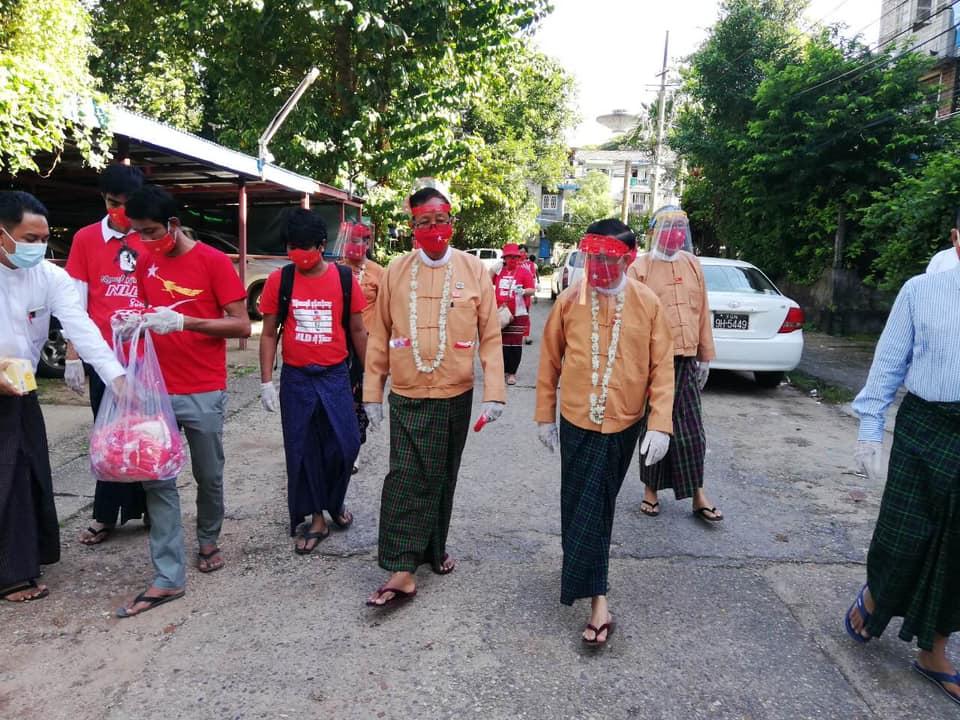
He is one of the ruling party’s fastest rising stars, and is tipped to take on a career-defining role as Yangon’s chief minister, aged 44, after Sunday’s election.
Ye Min Oo has served on the National League for Democracy (NLD) party’s influential information and economic committees and last year was appointed deputy mayor of Naypyitaw.
He has served as Yangon’s regional finance and planning minister since June this year, and on Sunday he hopes to win a regional seat in Yangon’s Dagon township.
In a party led mostly by geriatric veterans of the 1988 pro-democracy uprising, the charismatic Yangon native hopes to play a leading role among a new cohort of younger leaders.
But while he is relatively young and relatively new to politics, Ye Min Oo is deeply tied to the old military establishment via his various business interests.
He is involved in numerous companies that link him to military cronies and, in one case, a senior member of the opposition Union Solidarity and Development Party (USDP), the military’s proxy.
His current and former roles at different companies, many of which he has held while in public office, raise questions about potential conflicts of interest, an investigation by Myanmar Now has found.
One of his companies, the one linked to the USDP, is also over 9bn kyat ($7m) in debt, and an MP has raised doubts that the firm will be able to generate enough income to repay it.
Taxpayer-funded housing project years behind schedule
Ye Min Oo is in a fraught business partnership with Nandar Hla Myint, the 44-year-old spokesperson for the USDP.
The two own companies that have invested in a taxpayer funded housing project in Shan state that is worth billions of kyat and which has been stalled for years.
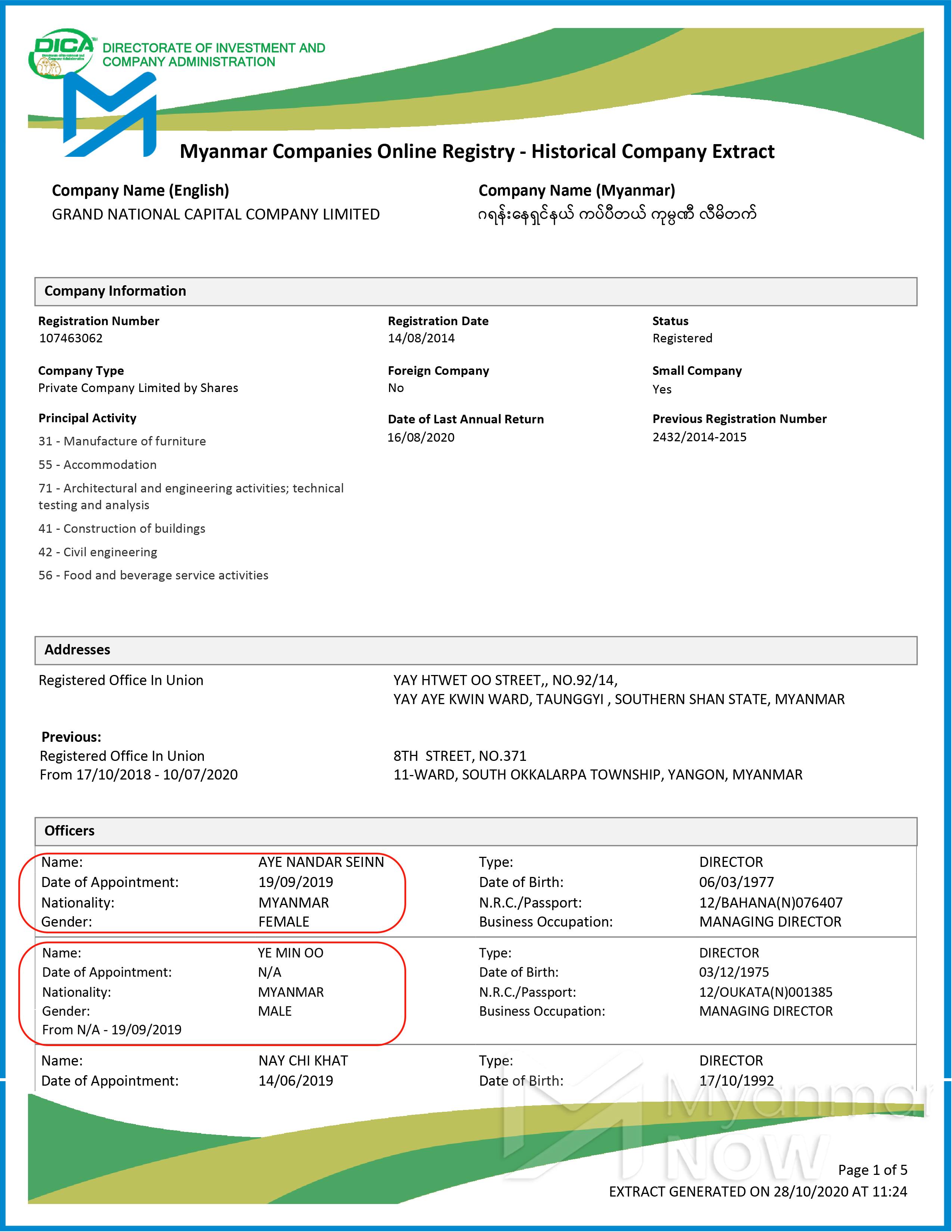
Ye Min Oo’s construction company, Grand National Capital (GNC), was set up in 2014 to serve as a subcontractor for Min Kyan Sit, another construction firm owned by Nandar Hla Myint.
Ye Min Oo’s wife, Aye Nandar Sein, was listed alongside him as director at GNC, which is registered in Yangon and Shan state.
Min Kyan Sit won a contract from the Shan state government to build a residential complex called Aye Tharyar to provide housing for retired civil servants in Taunggyi.
The complex, funded with the state’s regional development budget, was due to include 133 five-storey buildings, each of which would contain 20 apartments.
The Shan state government called a public tender for the project, but even before the winner had been announced, Nandar Hla Myint had ordered workers to begin surveying and clearing the land at the construction site, said Aung Win, managing director of A2Z, a construction company involved in the project.
Nandar Hla Myint and Ye Min Oo also met up with other entrepreneurs in the construction for negotiations before the bid winner was announced, other participants in the project told Myanmar Now.
A2Z built four of the five-storey buildings as agreed, Aung Win said, but never received the agreed fee for doing so. In 2015 he sued Min Kyan Sit in a bid to recover the money. The case is ongoing.
The contract between Min Kyan Sit and GNC, signed in September 2014, said GNC would build 48 five-storey buildings for the project.
Min Kyan Sit was to take responsibility for having the remaining units built, and hand the housing project over to the Shan state government by June 2017. But the project was never finished.
The company took out a 4bn kyat ($3.1m) loan from the Shan state government in order to fund the project, and was due to pay it back by handing a portion of the apartments to the government to be used as public housing. The company would then be allowed to sell the remaining properties for a profit. But it failed to finish the project, and with interest now owes the government 6bn kyat.
The company had agreed to give GNC over 5bn kyat ($3.8m) to build the 48 buildings it had signed on for, but GNC never got the money, and so halted its operations at the Taunggyi site in 2015.
In 2017, Ye Min Oo appealed to the Shan state government to be allowed to continue the construction of the apartments under GNC’s name, since Min Kyan Sit was not in a position to pay back its debt.
Representatives from GNC then came to meet the Shan state cabinet to negotiate permission to continue with the project in late 2019, a Shan state MP told Myanmar Now on condition of anonymity.
In September 2019 Ye Min Oo resigned from the board of directors at GNC. His wife Aye Nandar Sein still serves as GNC’s managing director.
On April 4 this year, the Shan state government called a meeting with Min Kyan Sit and GNC to find a solution for the stalled housing project. Ye Min Oo was present at the meeting despite the fact he has officially left the company, Shan state cabinet secretary Nay Lin told Myanmar Now.
Under a contract made at the meeting, and seen by Myanmar Now, Nandar Hla Myint’s company agreed to pay 1.6bn kyat by March 2021 while Ye Min Oo’s agreed to pay 2.4bn kyat within 60 days of the meeting.
The Shan state government will also take an extra 300 apartments in lieu of the 2bn kyat of accrued interest, the agreement said.
Deep in debt
Ye Min Oo’s company has passed the deadline to pay back the debt and sent a letter to the Shan state cabinet appealing for an extension until January next year, Nay Lin said.
“He requested an extension because of the current Covid-19 situation. The cabinet will make a decision based on this application, probably on November 13, after the election.
Sai Zay Seng, GNC’s director, told Myanmar Now in early October that GNC’s operations on the housing project would resume in November after the election.
In 2016, GNC mortgaged the machinery it had bought for the Aye Tharyar housing project for 7bn kyat ($5.4m) from a local private bank. By June this year the total amount outstanding, including interest, was over 9.7bn kyat, according to an NLD MP who is a member of the parliamentary committee overseeing finance and business affairs.
“We don’t even know if he still has the mortgaged machinery,” said the MP who asked not to be named out of fear of repercussions from within his party.
He is keeping an eye on GNC since the company does not have a source of income to pay off the debt, the MP added.
Myanmar Now contacted Ye Min Oo several times for comment on the Aye Tharyar project and the outstanding loan. Late last month he replied via Facebook messenger.
“I have no comments on this. If you are confident this is correct, please go ahead and write about it,” he wrote.
Nanda Hla Myint also refused to comment on the partnership and referred Myanmar Now to the Shan regional cabinet.
Conflict of interest?
Ye Min Oo held high ranking positions at the Htoo Group and its subsidiary, AGD Bank, owned by well-known military crony Tay Za, before resigning in 2014.
He then founded GNC, Sky Capital and Atlas Veritas Aequitas (AVA). And he worked as a director, chair, or consultant as several financial companies and private entities. Myanmar Now found at least nine companies where he held managing roles.
He was appointed chair of Naypyitaw Sibin Bank in early 2019, just months before he became vice mayor of Naypyitaw.
Records from the Directorate of Investment and Company Administration (DICA) show that Ye Min Oo remained in several senior roles at private companies while serving in public office.
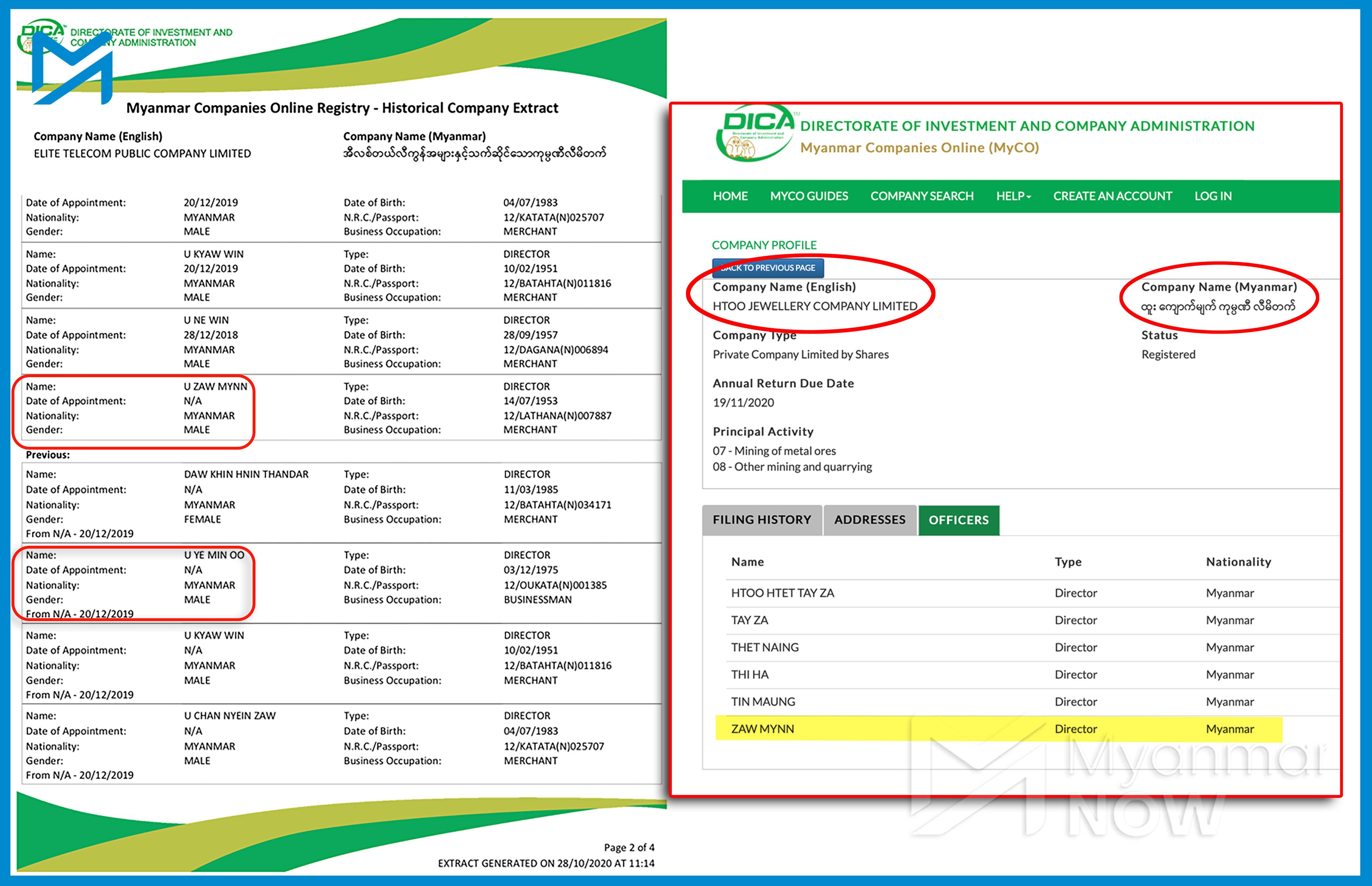
He continued to manage Goen Mandalay, Elite Telecom, AVA, Pinus Pinaster, Inle Future Development and GNC even after becoming a high-ranking government official.
He was the chair of the Rakhine Coastline Development Public Company until September 2019, and a director at Pinus Pinaster Limited and Elite Telecom until November and December 2019.
While he eventually resigned from the majority of those companies between September and December last year, he stayed on at two of them until early this year and October. His wife Aye Nandar Sein replaced him as either chair or a director at most of the companies he left.
And even though Ye Min Oo left the Htoo Group in 2014, it appears he remains closely linked to Tay Za.
Directors at Elite Telecom, where Ye Min Oo worked until December 20, also hold high-ranking positions at the Htoo Group, DICA records show.
Chang Kwan Lu, also known as Zaw Mynn, is a director at Elite Telecom and a close confidant of Tay Za. He is also a director at Htoo Jewelry and a patron of the Htoo Foundation.
Documents published by Wikileaks show that Chang Kwan Lu helped negotiate the deal with the Chinese company Wanbao to invest in the controversial Letpadaung copper mine.
Myanmar does not have specific laws barring regional ministers from serving in senior positions in the private sector while in office, but Ye Min Oo’s close ties to military-linked corporations suggest he may face serious conflicts of interest if he is appointed Yangon’s chief minister.
Earlier this year, two directors from Myanma Economic Holdings Limited (MEHL), a military conglomerate, were made to resign because they also led the government’s customs department and the Myanma Port Authority.

Their resignations came after Myanmar Now reported on the potential conflict of interest; MEHL has sweeping import and export operations. The President’s Office said at the time that the directors were in violation of vaguely worded sections of the 2013 Civil Service Personnel Law.
Although Ye Min Oo has held senior roles at multiple private companies while in government office, the President’s Office has so far not felt obliged to act in the same way it did against the MEHL directors.
The President’s Office did not respond to Myanmar Now’s request for comment on whether Ye Min Oo may also be in violation of the civil service law.
The law does not explicitly bar public officials from holding positions at private companies, but it does require the officials to follow regulations set by their departments, which may include bans on holding such positions.
Ye Lin Myint, the national coordinator at Myanmar Alliance for Transparency and Accountability, said that while Myanmar still does not have strong regulations to prevent conflicts of interest, all candidates for public office should be made to disclose their business assets, as well as those of their relatives.
“We welcome young people and business owners who participate in politics but transparency is the key aspect,” he said. “What is more important is that those who are high-ranking officials and hold political positions in the cabinet need to disclose their assets and businesses transparently.”
The NLD’s spokesperson and central executive committee members refused to comment on Ye Min Oo’s business interests.
In an interview with 7Day news earlier this year, Ye Min Oo said that even though he had met several top military officials in his life, he has never asked anything of them.
“I have never associated with anyone to perpetuate an unfair advantage or to get a project,” he told the newspaper.